Nokken

Copenhagen is, in some ways, a city like any other. It is full of pedestrian traffic, buses, bikes, and taxis. There are shops lining the streets, cafés on every corner, and apartment buildings in the city center and on the outskirts. However, it differs from most cities in its inclusiveness of both lower and upperclass living situations.

Early this week Hermione invited me to join her in exploring a village called Nokken, which is comprised of rows upon rows on tiny homes. Nokken is located on the outskirts of the city, across long bridge and past when the strand turns off to the right.

Tiny homes and their offerings have flooded social media of late. The ones I’ve seen in the US often come equipped to be hauled by any vehicle with a hitch. Thus they offer an opportunity to quite literally buy a home away from home wherever you choose to travel (at least on land).

The tiny homes in Denmark are much more sedentary than those I’m accustomed to seeing. The particular neighborhood that we viewed consisted of homes that I assumed, before viewing them, are meant to be lived in year round. However, when we walked around, we both noted how quiet the neighborhood seemed. We saw many padlocked homes with far overgrown lawns and poorly organized lots. We also heard very few noises from conversation or children. In fact, we only saw three people even through we walked the length of the village and back on two different paths. This made us come to the likely conclusion that many Danes may use these homes as weekend getaways or summer homes. We also recognized that having children in these tiny homes may not be optimal and would partially explain the lack of noise.

It was also interesting the note the stark difference between the town homes and the nearby apartment buildings whose shadows loomed over the smaller houses.

The photo below demonstrates both the neglect shown to some of the lots as well as the contrast between the large structures of the city to the tiny homes:


Hostel Cooking

Hermione, Emily, and I have been trying to cook our dinners Monday through Friday every week and only go out to eat on the weekends. That way, because our breakfast is also already paid for, we only end up spending money on lunch during the weekdays. This allows us to put our money towards other uses. For Emily, that means buying multiple fun souvenirs for friends and family back stateside. For Hermione, it means adventuring to different museums and participating in various activities all over Denmark. For me, it allows me to save some extra money for the coming two weeks that I will spend gallivanting across Europe with my older sister, Tori.

Cooking in a hostel is pretty different from cooking at home. For one thing, you don’t have access to a well-stocked spice cabinet or a variety of oils to choose from. For another, there are almost always other groups of people in the kitchen cooking their meals at the same time that you are trying to cook yours. To remedy the first difficulty, Hermione and I decided to get the bare necessities from a grocery store called Netto when we first arrived. This purchase included things like salt, pepper, vegetable oil, olive oil, a spice mix, butter, and milk. In an attempt to avoid the second difficulty, we try to cook at somewhat unusual meal times. Our attempts usually fail, however, because of the workdays we spend with our teams.

We started off by splitting the cost of each meal between those who ate, but that quickly became too much hassle and we decided to just take turns buying the groceries. Some of my favorite meals from this trip have been eaten in the hostel basement. This is a fact I never thought would be true before coming on this trip. I think more than the food, it’s just nice to spend some quality time talking and laughing with Emily and Hermione. We all take turns cooking, washing dishes, drying them, and then putting them away. It’s also fun to smell the different spices being used by other hostel patrons. At any given moment, especially around 6:30 pm, the hostel’s kitchen will be bustling with movement and at least three languages can be heard. Some families may be cooking Italian pasta, while another fries vegetables in a pan, and yet another bakes cookies on a sheet in the oven. Below is a photo of two meals we’ve cooked this week!

ParkRun 5K

Last week, Hermione convinced me to go run a 5K with her at a local park. The 5K is part of an organization called ParkRun, which works to establish weekly runs in neighborhoods all over the world. The group has started races paths in Australia, Canada, Denmark, France, and many other countries.

We woke up on Saturday morning, avoided eating breakfast, and biked the few miles over to the park at about 9:30 AM. We rode our bikes straight past the starting point because only two people were gathered and we assumed the group must meet further down the gravel path. When we started seeing cattle we decided to turn back and ask the two men we had passed earlier where we should go. When we got back to the clearing it looked completely different. There were maybe thirty people standing around. They ranged in age from approximately five years old to maybe sixty-five.

When the race began, a couple of the youngest kids rode their bikes, but everyone else took off on foot. I was decently confident going into the race. I never thought I would be one of the fastest runners by far, but I thought I could finish pretty easily at least. I run a mile at least every other day and I work out everyday at the gym. There were two flaws in my confidence: first, I actually thought a five kilometer run was approximately two miles not three, second, I stayed on the treadmill too long the day before and started the race with already sore muscles.

Fortunately, Hermione is a wonderful running partner and she kept me motivated enough to finish the run within a reasonable amount of time, even if we did cross the line after some of the senior citizens. In our defense, they were incredibly fit! One of them even received a t-shirt for completing her 250th 5K, which was given to her prior to the start of the run. There was some fanfare and photos were taken of the accomplished runner.

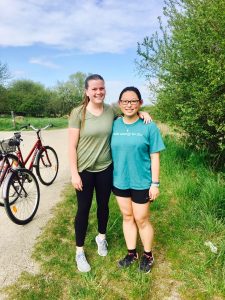
The Danes were all very kind and supportive of everyone participating, so Hermione was not the only person cheering us on. Many onlookers stood on the sidelines near the starting point and clapped and called out encouragement as we jogged by them. One man passed us at one point, waved for us to join him, and said, “let’s finish strong.” At least, that’s what we decided he probably said to us. Overall, the run was a fun experience and I’m glad Hermione was able to convince me to accompany her. The photo below shows both my happiness from doing something different and my relief that I wouldn’t have to run any more that day.

Nyhavn

Nyhavn, one of the most popular tourist destinations in Denmark, invites anyone who visits to admire its colorfully painted townhouses, shops, bars, and restaurants. Between spending some time in Copenhagen with my father after my senior year of high school, coming back to spend two weeks here last spring, and now, living here for a month, I have visited Nyhavn quite a few times.

I prefer to go early in the morning before it gets too busy with tourist traffic. I find it interesting to think of what it may have looked like in days long past. In the 1600s, Christian V forced imprisoned Swedish soldiers to build the dock as a trade route to connect the vast ocean waters to the inner city and the royal palace. At the time, the port was viewed as a necessity for luxuries and food to be brought into the city, but it was also infamous for hard knuckled sailers, drinking, and prostitution.

A few centuries later, Nyhavn still bustled with trade and it had become a place of community, wealth, and the arts. In 1754, the Charlottenborg Palace (as it is known today) was built to house the Royal Danish Academy of Fine Art. Later, in 1845, the famed Hans Christian Andersen moved into Nyhavn 67 and stayed their until 1864. Hans Christian Andersen is today viewed as one of the greatest fairytale authors of all time. Some of his most esteemed and well-known works include ThumbelinaThe Little Mermaid, and The Ugly Duckling. Andersen lived in Nyhavn for approximately two decades. In 1864 he left Nyhavn for several years. He returned in 1871 and moved into Nyhavn 18. Even today, Nyhavn 18 is home to his memory, as it has been converted into a H.C. Andersen tourist shop.

When World War II swept across Europe in the 1940s, Nyhavn’s trade practices took a major shift. For the past few decades, sea traversing ships had grown to be far too large to fit into Nyhavn’s port. Smaller ships had worked with their larger counterparts to continue Nyhavn’s trade of goods, but during the war, trade routes that replaced the small port were forged over land. Nyhavn became largely deserted as its purpose had been transposed.

After two decades, the Nyhavnsforeningen or Nyhavn Society, was founded to transform the area and take it back to its former glory. Since its revitalization, Nyhavn has served as a major attraction and veteran ship and harbor museum.

Sources: http://justincremer.com/words/features2/nyhavn.html, https://en.wikipedia.org/wiki/Nyhavn, http://www.biography.com/people/hans-christian-andersen-9184146

Every Child Left Behind?

There are many things that I respect about the Danish way of life. I love wearing all black, riding my bike all over the city, and admiring the mix of ancient and modern architecture that makes Copenhagen so unique. There are only two Danish habits that I’ve come across that utterly confuse me. The first is silly, but I just cannot stomach herring. I don’t care if you bake it, pickle it, or cover it in mayonnaise, I learned my lesson last year and I won’t go near that fish again. The second thing is a bit more serious and, in my opinion, more concerning. I cannot fathom what would provoke a parent to leave their child outside without them. Maybe that’s unfair of me, and perhaps it’s a custom that is perfectly reasonable here, but I can’t seem to wrap my mind around it.

When you walk around the city, even if the weather that day is cold and dreary, you will pass multiple strollers outside café windows. Strollers that are not accompanied by any adults. The first time you see one, you may assume that the parents simply carried the child inside without the cumbersome baby carriage. If so, you likely would be incorrect. The child is left outside while their parents grab a bite to eat or a cup of tea or whatever they choose.

I grew up in a very calm, quiet, tiny town in Texas, but even so, I have never seen someone intentionally leave a child alone outside. To be fair, it’s harder to be in a safer society than Denmark, especially as far as child abduction is concerned. From what I’ve read, there have been fewer than five child abduction cases in the last three decades. According to the National Center for Missing and Exploited Children, nearly eight hundred thousand children are reported missing each year in the United States. This number is skewed because of parent abductions, but child abduction by a stranger is still obviously far more prevalent in the USA than it is in Denmark.

Though it may be safe to leave a child outside a cafe in Denmark, I certainly would not recommend a similar action in the United States. My inability to fully understand the common practice of leaving your child alone with strangers passing by them constantly probably arises because of this extreme difference in the child’s safety.

I Want to Ride my Bicycle, I Want to Ride my Bike

Today, Daniel and I went to the bike shop recommended to us by DIS. It is located about three minutes away from DIS and is pretty easy to find. Pro-tip: the shop will not show up if you try to google it, but you can find the address on the DIS website.

I don’t know exactly what I was expecting when we arrived at the bike shop, but it certainly wasn’t a tiny shop in a cement basement with a line of bikes chained together outside the door. In hindsight, that all seems perfectly reasonable, but at the time, I’m honestly just glad I didn’t go alone because it was a bit intimidating. All was well once we met with the man running the shop. He was extremely helpful and kind, as most of the Danish are as long as you’re respectful.

Something else about the trip was unexpected too. I thought surely it would be a bit costly to rent a bike because of insurance, locks, maybe cleaning supplies. I don’t know. I’m definitely not all that familiar with what serious, everyday biking actually entails. I was expecting maybe twenty-five dollars a week. I was way off. It was only forty dollars for four weeks, less than half of what I thought. I was pleasantly surprised and excited to try out my new wheels.

I grew up riding my bike, or my horse honestly, around my old neighborhood in west Texas, but riding a bike in the busy streets of Copenhagen is obviously a whole different ball game. I had completely forgotten about hand signals, so I found this refresher very helpful. http://abcstudentbikes.dk/source/files/media/dis-biking-handbook.pdf

In case you don’t want to read the link—right arm stretched out beside you warns other cyclists that you intend to turn right, right arm bent so that you forearm is parallel to your body and your fingers point at the ground warns them that you will stop, and to turn left you must dismount your bike and cross the street on foot at the nearest crosswalk.

Daniel and I made it back to the hostel without any real excitement, which is a good thing. We locked up the bikes by wrapping our chains around the our bike’s back wheels and bike frames, just as we were told to do earlier at the shop. But as we walked into Danhostel, Daniel noticed that I’d left my backpack on my bike. Thankfully no one had taken it in the previous thirty seconds, but it certainly made me wary about forgetting to check my bike’s basket.

If any of the first years happen to read this: first, get ready because Copenhagen is a fantastic city to visit; second, I highly recommend getting a bike while you are here. Even though I’ve only had mine for one day, I am already loving the convenience of being able to get basically anywhere in the city center within ten minutes. Apparently, wearing black isn’t the only thing I’m going to copy about the Danish way of life. It looks like I’ll need to air up my old bike tires when I get home.

Feeling a Little like a Local

Last year, I attended the Business 180 spring term class that spends two weeks in Copenhagen. After the first few days, I felt like I was at least reasonably competent in my abilities to traverse the city. Like Cassidy mentioned in her blog post “Maybe change isn’t that bad,” I also felt strangely calm when I arrived in Copenhagen for the first time. At every opportunity, my classmates and I ventured into the streets to find food, visit museums and churches, or even just to “do as the Danish do.”

Well, if you are trying to “do as the Danish do,” at least two things will probably happen: first, you’ll start to wear A LOT of black; and second, you’ll walk or ride a bike almost everywhere you go. The walking and bike paths in Copenhagen make it extremely easy to get around the city, even if you, like me, are directionally challenged. The architecture also helps.

Copenhagen boasts an interesting variety of architectural styles. The ancient structures of days gone by stand right next to impressive modern buildings like the Black Diamond Library and Royal Danish Theater. Because many of the buildings are so unique, I find it easier to figure out where I am in relation to where I am trying to go. The buildings also make it easier for me to pick a path to take.

Today, on the way to dinner at Paper Island, I knew that if I could either cross the bridge next to Danhostel and follow the waterway until I reached a footbridge that crosses to the food service area, or I could walk past City Hall onto the main pedestrian street, follow the street until it essentially ends in front of Nyhavn, and then cross the newly built bridge that connects Nyhavn to Paper Island. I honestly have no idea what any of these streets are called or whether I’m walking north, south, east or west, but I do know that walking next to the harbor is a bit colder because there is nothing standing between you and the chilling wind, but it takes less time than following the pedestrian street.

After dinner, I left Paper Island and decided to walk back on the other side of the harbor which is now a viable option because of the new bridge. I was almost to the part of the sidewalk where there are trampolines when a young girl split off from her family and walked over to stand directly in my path. She asked me if I knew where “the building full of food trucks” (aka Paper Island) was located. Her father followed her and looked at me hopefully.

I happily gave them directions and then finished walking home. I cannot believe that I know the streets of Copenhagen well enough to give strangers directions. I almost felt like a local taking short cuts and wearing black from head to toe with simple, comfy walking shoes. I can’t wait to spend the next four weeks getting to know Copenhagen even better.