Spring Sprung in Seconds

Copenhagen is cold, rainy, and windy through the brunt of the Spring, or so I was told. When packing, I made sure to bring numerous jackets, sweatshirts, and sweater, in order to cope with the wind. While the wind has remained, as it is ever-present in Copenhagen, the weather has certainly shifted since when I arrived. Our program might be finished but I figured I would spend a few extra days in Copenhagen with my sister who is also on a Euro-trip. Her arrival seemed to have brought the warmth to Copenhagen and it is near sweltering here.\, at least relative to my first few weeks.


Most of our time spent in Copenhagen was cool, crisp, and windy. Knowing rain could strike at the drop of a hat and that it is nearly impossible to predict the weather here, I always had a rain jacket our umbrella close by. Luckily, I can now enjoy the warmth of what seems to be Danish summer, although I have no summer clothes with me. What has been truly amazing to experience is how Copenhagen has transformed in a matter of days. From bleak yet beautiful to warm and lively.

Life seemed to be on pause near the beginning of our trip, with everything from the people to the plants protected in layers to keep the weather out. Since this heat wave has hit, everything in Copenhagen has come to life and the plants have all come out at once. Spring has happened in an instance. From buds hiding behind layers to flowers in full bloom, Copenhagen is lush in a way that is incomparable. Flowers are everywhere and the funny shaped trees which are everywhere now prove why they are cut and handle. Their knobby branches are filled with leaves and they are shaped beautifully, as if they are manicured every day. Bright green grass is everywhere and countless tulips are some of the most notable scenes in this beautiful space.

Even more incredible than the greenery are the people residing and enjoying these spaces. Given Denmark’s cold weather and lack of sunshine during most of the year, everyone flocks to big outdoor spaces when the weather turns. Parks are covered in blankets and towels with sunbathers as far as the eye can see. Music and children shrieks fill the air like never before. Noise was something that was absent in so many spaces. Copenhagen was very quiet for most of my stay here. This is no longer the case and happy sound seems to emanate from every direction. Outdoor seating is almost completely full at any café that offers it. Every glass seems to be filled with chilled beer, dripping with condensation.

While I have enjoyed every moment spent in Copenhagen, these few days have been incredible. Danish joy is palpable in this beautiful, summer-like weather. I have gotten to experience polar opposites and this has been an incredible and comprehensive way to know the city. My time here in Copenhagen will soon be coming to close but I will make sure to take all of it in these last few days.

My love for 7/11

One of my first observations here in Copenhagen was, “Wow, look at that 7/11. I love it.” Now, almost four and a half weeks later, my love for the Danish 7/11s persists. Before I am labeled as a weirdo (which some may already do), let me explain the reasoning behind my obsession.

First and foremost, the Danish 7/11s have freshly baked goods. Whether it be personal-size pizzas, blueberry muffins, or chocolate macadamia nut cookies, they have anything a professional late-night-snack-owl could desire. This is where I come into play.

Back in Lexington, I usually visit the 7/11 in the nighttime hours. Whenever I have hit a wall writing a paper or want to take a study break with friends, my favorite suggestion is getting some famous 7/11 Slurpee’s. Lexington’s 7/11 has pre-packaged snacks and some hotdogs rolling on a cooker, but nothing terribly appetizing.

However, here in Copenhagen, they have numerous displays filled with pastries and sandwiches. There are ovens behind the cashier counter, allowing customers to watch the employees as they pull out treys of cherry pastries and brownies. The store offers healthier options too. Yogurt parfaits and cold-meat sandwiches fill the refrigerated shelves. There is also a fresh pasta-salad bar right when you walk in the door. You grab your own bowl, fill it to your liking, pay, and you are on your way! These options are great for people in a time crunch who want to have something decent for lunch (i.e. not fast food) and want something at a below-average price.

As I converse with my fellow classmates, they say this “upscale” style of 7/11s is quite common in Europe and Asia. Honestly, if I had the means to, I would travel the world just to see the different 7/11s. A lofty goal? Sure. Does it make much sense? Nope, which is why I will not endeavor on that adventure. Nevertheless, the difference between the 7/11s in the United States and Copenhagen fascinates me. In Copenhagen, the stores are more than convenience stores used to buy junk food and soda. The stores have more substantial food options; one could purchase an actual meal and not simply an on-the-go snack. Back in the States, it seems as though 7/11 has a reputation for being a quick-stop shop for cheap, unhealthy snacks and mega-large sodas and Slurpee’s. I am not saying that is a bad reputation to have, but it seems to vary quite a bit from the perception of the 7/11s in Copenhagen.


Being Resourceful

Working on the stairs for 2 hours – no, this isn’t a posed picture. Emily was nice enough to take one for me when I asked.

I’m typing this blog post on my phone as I’m sitting on a staircase in one or the DIS buildings. My computer has just crashed (for the third time this morning) and I’m waiting for it to reboot. As strange as this sounds, one of my favorite things about being abroad is looking at the results that being resourceful can bring. Since we are in an unfamiliar environment and without many things we take for granted, even the easiest things can be more challenging than usual.

In an earlier blog post, Ellee had already described how we had to be creative when cooking with limited resources in the kitchen. Today, it was the Danish work-life balance that threw a loop into our plans.

Given that our presentation is tomorrow, it is really crunch time. We had decided to meet at our usual DIS location. However, all but one of the buildings were locked. In the building that was unlocked, none of the rooms were open until 11am. And this was how I ended up working on our project on a staircase in DIS. Furthermore, we could not go anywhere else. The wifi in the hostel has poor connectivity. And practicing our presentation in a coffee shop is just not a feasible option. In fact, most places around Copenhagen are not open very early on Sunday mornings, with many opening at 10am, if not later. As someone who has been up since 6:30am this morning, I find the situation a little frustrating. At the same time, it is a little humorous.

On the bright side, there is good wifi on this staircase and I have somewhere to sit. The working environment is quiet – who else would be here on a Sunday morning? We are quite spoiled at W&L, where the library is open at all hours of the day.

We talk about the Danish work-life balance frequently and the lack of places open on Sunday is one sign of that balance. Most shops, with a few exceptions, around town don’t open until 10 am at the earliest. Ellee was also telling me that there was not a church service earlier than the one she attends at 10 in the morning. Having grown up in a place where the work mentality was to always be on the go, it is strange to be in a city that is somewhat like Lexington on Sundays! But we all have to adapt to our surroundings and environment. Being somewhere unfamiliar simply means that you will just have to be creative and work with what you know and/or have. Often, it is these moments of resourcefulness that are the most memorable after a trip has concluded.

Throwing slight shade at urban planners

I have never been on a canal tour before today. Naturally, I imagined this majestic scene with gondolas and swans everywhere; however, I then snapped back to reality that this was Copenhagen and not Venice. Nevertheless, I was extremely excited to experience the city from its iconic waterways. As soon as I stepped on the boat and saw the driver eating a burrito, I knew this was going to be an epic tour. Also, having Anders as our tour guide was another indicator that this tour was going to be one for the ages.

Similar to his tour in Malmo, Anders pointed out the urban planning of Copenhagen. We began our tour in the heart of old town Copenhagen. The classic European architecture with beautiful sculptures ingrained around the buildings edges. Every intricate detail represented the elegant and extravagant period in which the buildings were constructed. If one were to Google search “Copenhagen, Denmark”, the majority of the images on the first page would consist of these classic buildings. In fact, I did Google search Copenhagen and the page was filled with images of Nyhavn, along with many other areas within the old city.

As we continued through our tour, the scenery began to change. Anders was first to note the shift in the building architecture and design. Our boat cruised past the old city and into a more modern terrain. Instead of seeing centuries-old structures, we were now faced with modern and cutting-edge apartment complexes. In a way, it almost seemed like a completely different city. Cranes towered over us as we sailed by, signaling the rapid expansion of the city.

During this section of the tour, Anders explained the city’s reasoning behind this expansion. Naturally, he had some strong feelings towards it. To be fair, if I was a native Copenhagen resident, I would most likely share those same feelings.

For example, after this year, Paper Island will no long be the delicious indoor food truck establishment. This incredibly successful and insanely popular spot, both for locals and for tourists, is going to be removed simply because the city wants to transform the building into an apartment complex. While I can see the city’s business reasoning behind the decisions, I cannot imagine being a local and knowing that one of my city’s attractions was being erased and replaced with apartments.

I understand it is important for a city to expand and adapt to its people’s needs, but who decides what is best for the locals? When we passed one of the newer apartment complexes, Anders mentioned that it used to be an abandoned building. Artists would use it as their studios and there would be parties in the building; Anders himself took a moment to reflect on the memories he made in the building when it was the popular late-night spot. I could not help but wonder, how many other locally popular areas have currently been confiscated and transformed in order to accommodate Copenhagen’s growing population?

Even though it is important for the city to “keep up” with the influx of people, I wonder when (or if) the city planners will begin to keep the best interests of the locals in mind when deciding upon further city expansion projects.

City Planning 101

At first glance, Malmo did not look that much different from Copenhagen. Both possessed the classic European architecture and quaint cafés lining the pedestrian zones. The only glaring difference I immediately spotted was the biking trend. Malmo did not have as many bikers as Copenhagen; however, their infrastructure was still one that designed for frequent bike transportation. In all honesty, I thought Malmo just looked like a stereotypical, picture-perfect European city. By the end of the day, my perspective of the city had completely changed.

All throughout the day, our insanely insightful and intelligent tour guide, Anders, continually pointed out the architecture and layout of the city. He started by asking us to observe any similarities and differences between Malmo and Copenhagen. Naturally, I could not help but think there really was not any. I know what you are probably thinking, “silly Emily”, which is an accurate thought: silly me.

While Anders did admit there were many similarities between the two cities, Malmo’s city infrastructure and layout was more than what meets the eye. At each stop on the tour, he discussed the reasoning behind the area’s urban design. He spoke of how the urban city planners took numerous factors into consideration when building different sections of the city. Obviously, the “common sense” factors were obvious: is this area pedestrian friendly? Is it designed for cars, bikes, or simply walking? Does the design increase traffic in and out of the local shops?

Yet, there were multiple factors Anders mentioned that I had never even considered. He touched on the topic of “human-scale” and how it influences people’s feelings and perspectives of the area. If the buildings are closer together in a city square, it creates a more intimate atmosphere for people. This makes sense, but I guess I had never really taken the time to understand that these easily noticeable observations were meticulously planned to make me feel a certain way. In fact, included in the description of “human-scale” included the aspect of building height. If people can see the building’s roof (i.e. if the building is not towering over them), that adds to the intimate aura.

Thinking back to large cities in the States, like New York City or Chicago, it now dawns one me why it is easy to “feel lost” in the sea of the city. It is tough to find tight, intimate atmospheres in the downtown of major metropolitan cities. Sure, there can be little nook-and-cranny spots that locals can consider their intimate spots, but they are not as frequent or grand as the areas of Malmo (or even other European cities). I think that is why I have heard so many people talk about the relaxing and chill atmosphere of Copenhagen. The urban planning of these cities is tailored to make visitors feel a certain way ,whereas it seems that in US cities it is more tailored to jam as many people into a tight space as possible.

Whether it be in Sweden, Denmark, or back home in the States, I will view public areas in a different light. Instead of thinking about how quaint and beautiful the buildings are, I will start thinking about what the various factors that create a specific atmosphere.

Nokken

Copenhagen is, in some ways, a city like any other. It is full of pedestrian traffic, buses, bikes, and taxis. There are shops lining the streets, cafés on every corner, and apartment buildings in the city center and on the outskirts. However, it differs from most cities in its inclusiveness of both lower and upperclass living situations.

Early this week Hermione invited me to join her in exploring a village called Nokken, which is comprised of rows upon rows on tiny homes. Nokken is located on the outskirts of the city, across long bridge and past when the strand turns off to the right.

Tiny homes and their offerings have flooded social media of late. The ones I’ve seen in the US often come equipped to be hauled by any vehicle with a hitch. Thus they offer an opportunity to quite literally buy a home away from home wherever you choose to travel (at least on land).

The tiny homes in Denmark are much more sedentary than those I’m accustomed to seeing. The particular neighborhood that we viewed consisted of homes that I assumed, before viewing them, are meant to be lived in year round. However, when we walked around, we both noted how quiet the neighborhood seemed. We saw many padlocked homes with far overgrown lawns and poorly organized lots. We also heard very few noises from conversation or children. In fact, we only saw three people even through we walked the length of the village and back on two different paths. This made us come to the likely conclusion that many Danes may use these homes as weekend getaways or summer homes. We also recognized that having children in these tiny homes may not be optimal and would partially explain the lack of noise.

It was also interesting the note the stark difference between the town homes and the nearby apartment buildings whose shadows loomed over the smaller houses.

The photo below demonstrates both the neglect shown to some of the lots as well as the contrast between the large structures of the city to the tiny homes:

Oh, the places you’ll go

The turbines at Amager Strandpark

The last time I was in Copenhagen, I stayed in the main touristy areas surrounding Tivoli and Strøget. While the old town is a beautiful area, there is so much more to the city that I missed. Armed with more time and a bike, I was determined not to make the mistake.

Running a Saturday morning 5k with parkun at Amager Fælled, clearing my head at Østedsparken and an impromptu stop at the Botanical Gardens before visiting the Geology Museum have taken me to a few of the different parks and green spaces. Although each park is somewhat different, they usually share similar characteristics. Most parks will have lots of green space, a lake, lots of ducks/birds/geese/swans and trails for running or walking. The parks are not usually very big in size – nothing on the scale of Central Park in New York City. However, they are dispersed throughout the city, meaning that everyone can find a park within biking, if not walking, distance.

One of my favorite places is the Amager Strandpark. It is slightly further out, about a 20 to 25-minute bike ride from DanHostel, but absolutely worth it! The area is a park, but it is also a beach. There’s a trail along the beach for those who want to roller blade, bike or walk. On a sunny day, the water is clear and probably a good place for a swim (when it is warm). The geographic location of Amager Strandpark provides for interesting sights: you can see planes taking off and land at the airport, wind turbines, Malmö and the Øresund Bridge connecting Sweden and Copenhagen.

Aside from the parks, which I have used as a place to relax and people watch, there are other interesting areas in Copenhagen. The most famous is Christiania, which is know for its green-light district and the fact that it is a proclaimed autonomous neighborhood in the middle of downtown Copenhagen. Another unique area is called Nokken. It is near the park Amager Fælled and is an area of miniature houses. The area is protected and therefore cannot be used in city planning. The place stands out among the new, modern buildings in the area not only because of the difference architecture, but also due to the lack of maintenance. Years ago, Nokken was probably a charming place with little houses and garden. Now, the charm is diluted by some houses that look like they need repairs and the gardens that are overgrown. However, I did enjoy walking around Nokken. It is an area of Copenhagen that I had never been to before and certainly a very unique place.

One of the most famous parks that I have yet to been is Fælledparken, which is on my ‘to see’ list. With just over a week remaining in Copenhagen, I am excited to see what other places I discover.

Feeling Like a Tour Guide

Friday and Saturday, the first years from W&L got here for their Business 180 class. Having already been here for two and a half weeks, I felt ready to show the group around Copenhagen.

Today, we were unfortunately unable to take our tour around Copenhagen. As a person who loves maps and exploring, I took this as a chance to explore around Copenhagen. Cassidy and I were heading to Nyhavn when we ran into a group of first years, who looked hopelessly lost. Cassidy and I took them under our wing and headed over to Nyhavn to let them take tourist-y photos. They were so excited to finally find where they had been looking for.

After that, we headed over to one of my favorite parts of the city: the sidewalk trampolines! Everyone took photos and videos of them jumping around. They tried to see who could jump between the trampolines.

Next, we hit another one of Copenhagen’s highlights: Paper Island! I loved being able to show them the incredible food of Paper Island. I introduced them to duck fat fries, Danish barbecue (surprisingly delicious), and monster mojitos. It is so weird for all of us to be legal to drink in Copenhagen, as none of us are legal to drink in the United States. I think that has been one of the strangest and most difficult things to get used to in Denmark; I can order a glass of wine with dinner and I will not be ID’ed.

We continued to walk around Copenhagen and explore all the city has to offer. One of the first years even said “I have already fallen in love with the city.” It was so rewarding to be able to combine my love of exploring, maps, and showing people around.

Growing up, my father had an incredible sense of direction, while my mom’s was to say it simply, terrible. I, luckily, inherited my father’s sense of direction. I grew up directing my mother around a city I have lived in for much shorter than she. With a map in hand when I was ten, (yes, a real paper map!) I could get my mother anywhere in Richmond. By middle school, I could navigate my way to just about any city in Virginia. I now am fairly confident getting anywhere on the East Coast.

Coming to Copenhagen, I was excited to navigate a new city. I picked it up fairly quickly; I can get anywhere in the city after one walk in the daylight.

I was more than thrilled to share my knowledge of the city today. I hope they can pick up on Copenhagen’s roads as quickly as I did!


The Markets

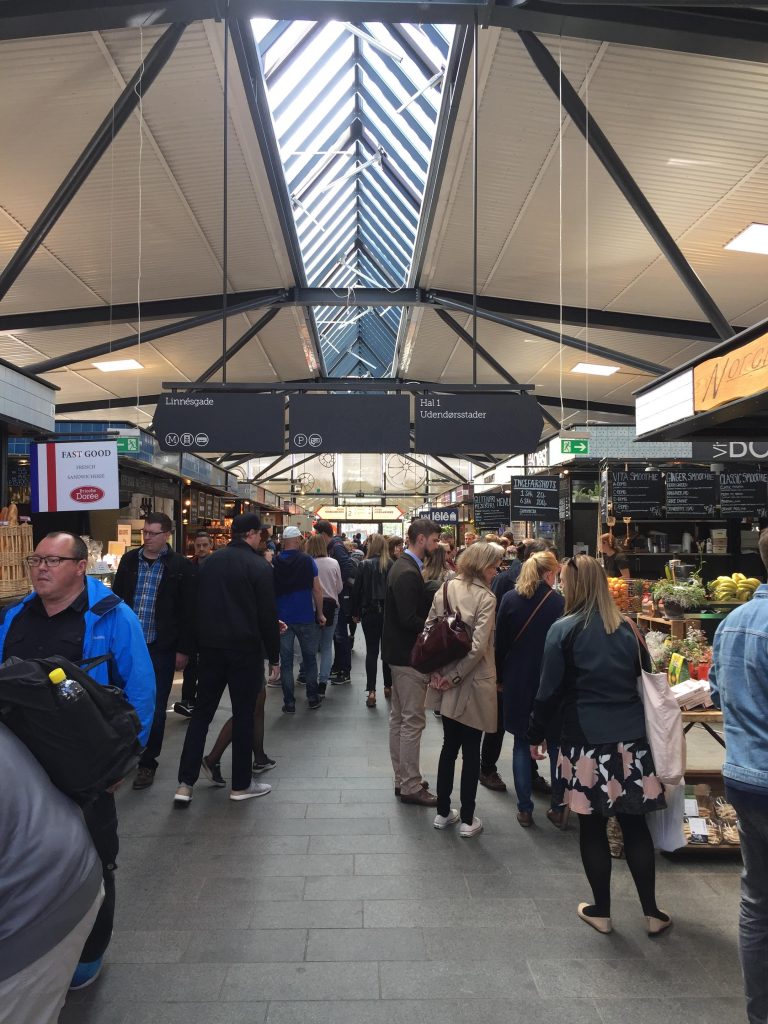
One of the two buildings at the Glass Market.


Two of my favorite places to visit are the Glass Market and Paper Island. These unique markets have ample food options and are perfect for indecisive groups. My group frequently works near the Glass Market so we have been there plenty of times since we have arrived in Copenhagen. The only place back home that is even comparable to these two Markets are malls in my area. However, the food options at both markets are much higher quality foods than in the malls, as most food options that malls offer are fast foods.

The coolest thing about these Markets is their uniqueness. Paper Island is quite literally its own island full of food and drink options. I originally thought this would be an odd place due to people’s description of the cow hanging from the ceiling but it is far from it. The lively atmosphere and food ranging from duck burgers to greek food attracts a large crowd. It’s hard not to want to just hang out there to listen to the music and watch the boats go by. One of my favorite things to buy here is the duck sandwich. Since Dean Straughan recommended it, I decided to get out of my comfort zone and try this and I was not disappointed. Although a tad greasy, duck is very tender and I am glad I tried it.

The Glass Market is two big glass buildings full of food as well. There they offer things such as sushi, sandwiches, French cuisine, smoothies, ice cream, duck sandwiches, pizza, fruit, vegetables, and chocolate. The Glass Market also has several butcher shops in one of the buildings for locals who would like to buy fish or meat. One of my favorite places to eat at the Glass Market is Un Mercato, a two-story restaurant located in the market that sells sandwiches, pasta, ricotta balls, etc. Although expensive, Un Mercato has sandwich specials such as a meatball or steak sandwich that are delicious. There is also a great lunch shop in the market that offers a drink and a sandwich for 77 Danish Kroner that I frequent as well.

In the next two weeks, I will continue to frequent these markets to try the different food options. It is impossible to try them all, but I am excited to take advantage of these unique places in the days to come.

Nyhavn

Nyhavn, one of the most popular tourist destinations in Denmark, invites anyone who visits to admire its colorfully painted townhouses, shops, bars, and restaurants. Between spending some time in Copenhagen with my father after my senior year of high school, coming back to spend two weeks here last spring, and now, living here for a month, I have visited Nyhavn quite a few times.

I prefer to go early in the morning before it gets too busy with tourist traffic. I find it interesting to think of what it may have looked like in days long past. In the 1600s, Christian V forced imprisoned Swedish soldiers to build the dock as a trade route to connect the vast ocean waters to the inner city and the royal palace. At the time, the port was viewed as a necessity for luxuries and food to be brought into the city, but it was also infamous for hard knuckled sailers, drinking, and prostitution.

A few centuries later, Nyhavn still bustled with trade and it had become a place of community, wealth, and the arts. In 1754, the Charlottenborg Palace (as it is known today) was built to house the Royal Danish Academy of Fine Art. Later, in 1845, the famed Hans Christian Andersen moved into Nyhavn 67 and stayed their until 1864. Hans Christian Andersen is today viewed as one of the greatest fairytale authors of all time. Some of his most esteemed and well-known works include ThumbelinaThe Little Mermaid, and The Ugly Duckling. Andersen lived in Nyhavn for approximately two decades. In 1864 he left Nyhavn for several years. He returned in 1871 and moved into Nyhavn 18. Even today, Nyhavn 18 is home to his memory, as it has been converted into a H.C. Andersen tourist shop.

When World War II swept across Europe in the 1940s, Nyhavn’s trade practices took a major shift. For the past few decades, sea traversing ships had grown to be far too large to fit into Nyhavn’s port. Smaller ships had worked with their larger counterparts to continue Nyhavn’s trade of goods, but during the war, trade routes that replaced the small port were forged over land. Nyhavn became largely deserted as its purpose had been transposed.

After two decades, the Nyhavnsforeningen or Nyhavn Society, was founded to transform the area and take it back to its former glory. Since its revitalization, Nyhavn has served as a major attraction and veteran ship and harbor museum.

Sources: http://justincremer.com/words/features2/nyhavn.html, https://en.wikipedia.org/wiki/Nyhavn, http://www.biography.com/people/hans-christian-andersen-9184146